Genetic factors

Recent research has shown that genetic predisposition plays a key role in the development of many mental health issues.
For instance, between one-third and two-thirds of children whose parents have mental health problems will go on to develop mental health problems themselves.Uher, R., Pavlova, B., Radua, J., Provenzani, U., Najafi, S., Fortea, L., Ortuño, M., Nazarova, A., Perroud, N., Palaniyappan, L., Domschke, K., Cortese, S., Arnold, P.D., Austin, J.C., Vanyukov, M.M., Weissman, M.M., Young, A.H., Hillegers, M.H.J., Danese, A., Nordentoft, M., Murray, R.M. and Fusar-Poli, P., 2023. Transdiagnostic risk of mental disorders in offspring of affected parents: a meta-analysis of family high-risk and registry studies. World Psychiatry, 22(3), pp.433–448.
The role of genetics varies according to the mental health issue. For example, bipolar disorders have a relatively large genetic component, while environmental factors play a bigger role in the development of post-traumatic stress disorders.
Mental health issues commonly influenced by genetics
There are several common mental health issues to which genetics can predispose us. These include:
Genetic testing
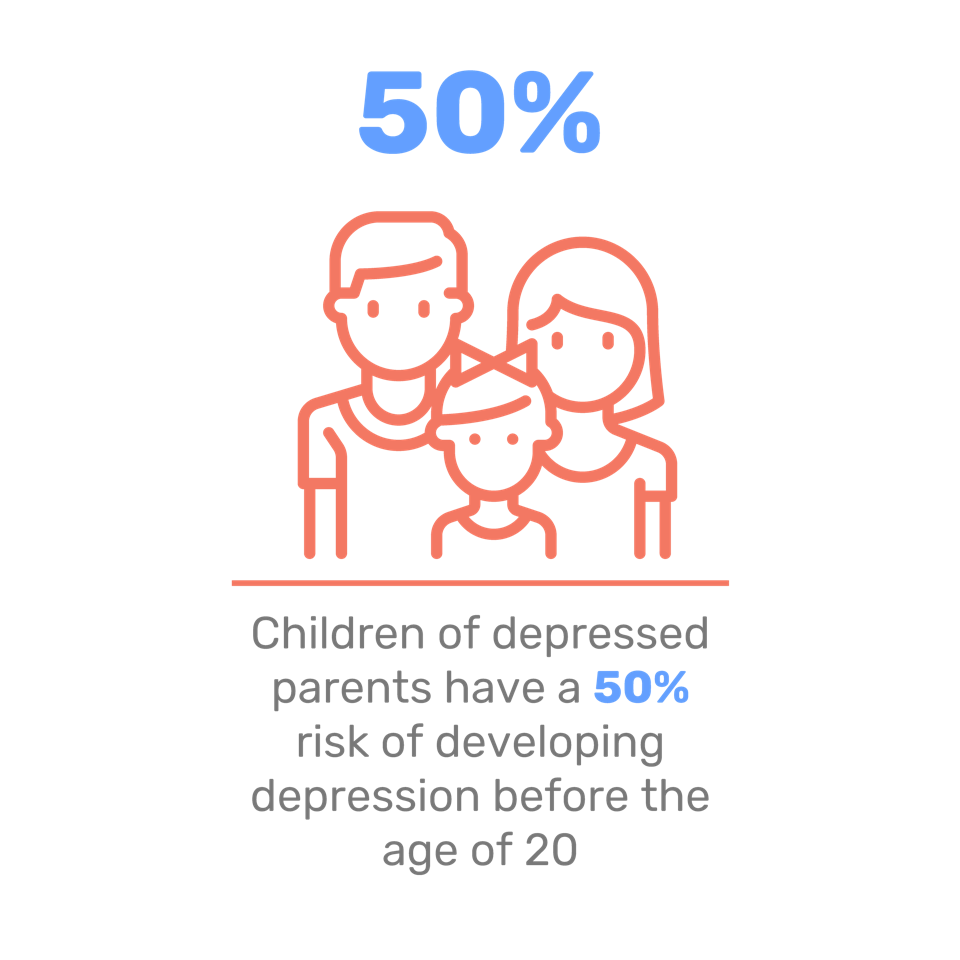
World Health Organisation. (2004). ‘Prevention of mental disorders: effective interventions and policy options’. [online] Geneva: World Health Organisation, p.29. Available at: http://www.who.int/mental_health/evidence/en/prevention_of_mental_disorders_sr.pdf [accessed 9 Aug. 2017].
Doctors can run various genetic tests to identify our predisposition to certain mental health issues. These tests involve taking samples of our blood or tissue, and looking for:Royal College of Psychiatrists, 2023. The role of genetic testing in mental health settings (College Report CR237). London: Royal College of Psychiatrists.
- A specific gene
- Any mutation on a specific gene
- A specific mutation on a specific gene
Genetic testing can also help to ascertain which treatments might be the most effective.Bousman, C.A., Al Maruf, A., Ferri Marques, D. and Müller, D.J., 2023. The emergence, implementation, and future growth of pharmacogenomics in psychiatry: a narrative review. Psychological Medicine, 53(17), pp.7983–7993.
This field is in its early stages, but is making rapid progress.
The role of epigenetics in mental health
Often, genetic and environmental factors contribute together to mental health symptoms. This is due to the impact of epigenetics.
‘Epigenetics’ – literally, ‘on top of’ genetics – refers to the way our environment turns genes ‘on’ or ‘off’. Certain environmental triggers can override our gene expression, silencing a ‘bad’ gene or promoting a ‘good’ one. This is known as the ‘epigenetic effect’.Montel Hayes, R., Mason, C.E. and Miller, J.J., 2025. The clinical use of epigenetics in psychiatry: a narrative review of epigenetic mechanisms, key candidate genes, and precision psychiatry. Frontiers in Psychiatry, 16, p.1671122.
Though research is ongoing, it’s difficult to work out the precise ratio of genetic and environmental influences on mental health.
Genetics, mental health, and our environment
Because of the effect of epigenetics, people who have genetic markers for mental health issues need to be especially careful about their lifestyle and environment.
Plenty of factors can exacerbate a genetic predisposition to mental health problems, including: