Difficult economic and environmental circumstances

Our external circumstances, including our work, income, living conditions, relationships and educational background have a significant impact on our mental wellbeing.
Difficulties in these economic and environmental circumstances can both contribute to, and exacerbate, mental health issues.
There is a strong link between difficult socio-economic circumstances and mental health issues in children and adults. Reiss, F., Erhart, M., Kaman, A., Devine, J., Zoellner, F. and Ravens-Sieberer, U. (2026) ‘Tracing socioeconomic inequalities in children’s and adolescent’s mental health: longitudinal study findings from 2017 to 2024’, BMC Public Health, 26. Guan, N., Guariglia, A., Moore, P., Xu, F. and Al-Janabi, H. (2022) ‘Financial stress and depression in adults: a systematic review’, PLOS ONE. Thomson, R.M., Igelström, E., Purba, A.K., et al. (2022) ‘How do income changes impact on mental health and wellbeing for working-age adults? A systematic review and meta-analysis’, The Lancet Public Health.
Economic difficulties and living in unhealthy environments can cause huge mental and physiological stress, which can lead to mental health issues such as
‘Socio-economic status’ refers to a person’s wealth, employment status, level of education, and living conditions.
Poverty is one major socio-economic difficulty, and the frequent cause of other problems.
Difficult socio-economic circumstances typically overlap, and include:
- Low levels of education
- Low levels of skills
- Unemployment
- Long work hours
- Low pay
- Crowded, urban, or insecure living conditions
- Incarceration
- Homelessness
- Poor transport and neighbourhood facilities
We know that there is a strong correlation between difficult socio-economic circumstances and mental health issues in children and adults.Mental Health Foundation (2024) Poverty: Statistics. Available at: https://www.mentalhealth.org.uk/explore-mental-health/statistics/poverty-statistics (Accessed: 28 July 2026). Reiss, F., Erhart, M., Kaman, A., Devine, J., Zoellner, F. and Ravens-Sieberer, U. (2026) ‘Tracing socioeconomic inequalities in children’s and adolescent’s mental health: longitudinal study findings from 2017 to 2024’, BMC Public Health. Guan, N., Guariglia, A., Moore, P., Xu, F. and Al-Janabi, H. (2022) ‘Financial stress and depression in adults: a systematic review’, PLOS ONE.
These circumstances can both contribute to, and result from a mental health problem:Mental Health Foundation (2024) Poverty: Statistics. Available at: https://www.mentalhealth.org.uk/explore-mental-health/statistics/poverty-statistics (Accessed: 28 July 2026). Money and Mental Health Policy Institute (2019) How does being in financial difficulty affect your mental health?Available at: https://www.moneyandmentalhealth.org/money-and-mental-health-facts/ (Accessed: 28 July 2026).
- Amongst people who live in poverty, every fifth adult is twice more at risk of experiencing a mental health problem as those on average incomes
- People without a degree are almost twice as likely to experience depression as those who have one
- People with mental health issues are three times as likely to be in debt as those without, and more than twice as likely to have problems managing money
Difficult environmental conditions often correlate with difficult socio-economic conditions, though even people who do not suffer from poverty but live in an urban environment can also experience difficult environmental circumstances.
These can manifest as:
- Living and/or working in polluted homes, offices and areas
- Living in a dangerous area
- Living far from public transport, educational facilities, shops
- Living and working in cramped and crowded spaces
- Living with noise pollution
- Living far from nature and green
All these can be detrimental to our mental health, causing psycho-spiritual stress, and disrupting our biochemistry.
How these circumstances can affect our mental health
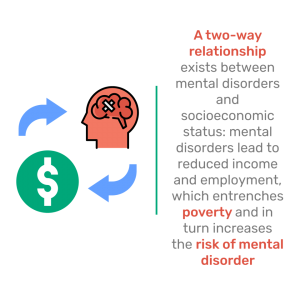
Experiencing poverty, unemployment, incarceration, natural disasters, war, homelessness and poor living environments can increase the following factors, which have been shown to contribute to mental health issues:
- Stress
- Difficult social circumstances
- Poor sleep
- Nutritional imbalances
- Gut issues
- Hormone imbalances
- Toxicity
Below are some examples of particularly difficult economic and environmental circumstances, and how they can affect our mental health.
Homelessness is a significant contributor to mental health issues:Barry, R., Anderson, J., Tran, L., Bahji, A., Dimitropoulos, G., Ghosh, S.M., Kirkham, J., Messier, G., Patten, S.B., Rittenbach, K. and Seitz, D. (2024) ‘Prevalence of mental health disorders among individuals experiencing homelessness: a systematic review and meta-analysis’, JAMA Psychiatry, 81(7), pp. 691–699.
- 30 to 50% of homeless people experience mental health problems, and 70% misuse drugs
- Mental and behavioural issues among homeless children and mothers are significantly higher than in the general population
- One in every four homeless people will die by suicide
- Homelessness is correlated with addiction, itself correlated with mental health issues
Like homelessness, incarceration is a significant contributor to mental health issues:Prison Reform Trust (2024) Bromley Briefings Prison Fact File. Available at: https://prisonreformtrust.org.uk/ (Accessed: 28 July 2026). Howard League for Penal Reform (2024) Self-harm in prisons at highest level for at least 20 years. Available at: https://howardleague.org/news/self-harm-in-prisons-at-highest-level-for-at-least-20-years/ (Accessed: 28 July 2026).
- Up to 90% of prisoners in the UK have a mental illness or substance abuse problem
- 72% of male and 70% of female prisoners have at least one mental health issue, and 20% of prisoners have four major issues
- Of prisoners aged between 16 and 20, 85% show signs of a personality disorder, and 10% of a psychotic illness
- 30% of prisoners have a history of self harm
- Women represent only 6% of the prison population, yet in 2003 they accounted for 46% of all reported self-harm incidents
- The suicide rate for men in prison is five times higher than for men in the community
- Boys aged 15 to 17 are 18 times more likely to commit suicide in prison than in the community
Worldwide, between 1/3rd and 1/2 of those affected by conflict, war, displacement, and natural disasters suffer from mental distress. The most common of these are:World Health Organization (2022) cited in: Lim, I.C.Z.Y., Tam, W.W.S., Chudzicka-Czupała, A., McIntyre, R.S., Teopiz, K.M., Ho, R.C. and Ho, C.S.H. (2022) ‘Prevalence of depression, anxiety and post-traumatic stress in war- and conflict-afflicted areas: a meta-analysis’, Frontiers in Psychiatry.
- Anxiety
- Depression
- PTSD (post-traumatic stress disorder)
Below are some of the mechanisms which explain the effects on mental health that these difficulties can have.
Living in difficult circumstances can be a huge source of long-term worry and stress, which is a well-known contributor to mental health issues.
In the US, researchers at Carnegie Mellon University and Brandeis University have shown that financial stress is correlated with higher cortisol levels, which are in turn correlated with depression, anxiety, and insomnia.Ettman, C.K., Fan, A.Y., Philips, A.P., Adam, G.P., Ringlein, G., Clark, M.A., Wilson, I.B., Vivier, P.M. and Galea, S. (2023) ‘Financial strain and depression in the U.S.: a scoping review’, Translational Psychiatry.
On the biochemical level, chronic stress can disrupt the production of hormones and neurotransmitters, as well as regular gut function, which in turn affects our mental health.Warren, A., Nyavor, Y., Beguelin, A. and Frame, L.A. (2024) ‘Dangers of the chronic stress response in the context of the microbiota-gut-immune-brain axis and mental health: a narrative review’, Frontiers in Immunology.
Read more about how your mental health can be impacted by:
Difficult economic and environmental circumstances can mean that we have restricted access to activities, environments and resources that would usually help to reduce our stress levels, improve our mood and help ensure our physical and mental health. These can include:
- Less money and time to spend on positive habits
- Buying and cooking nutritious food
- Exercise and gym membership
- Limited access to nature or green spaces
- Reduced opportunity to learn about good mental health practices
- Less money and time for mental therapies, mind-body therapies, etc.
- In low-income areas, treatment and prevention for mental health issues are likely to be less accessible
Read more about how your mental health can be impacted by:
Difficult environmental conditions can lead to chronic exposure to high levels of toxins through pollution in the air, water, the home, etc… Combined with a more limited access to nature and green spaces, and in conjunction with chronic stress, this can cause a substantial toxic overload which can negatively impact mental health.
- The stress from difficult economic lifestyles can lead to negative lifestyle habits, such as drinking, smoking and substance abuse
- Long-term unemployment, poverty, poor housing and lack of education all correlate with higher rates of substance abuse
- Levels of substance abuse are significantly higher in the homeless population than the general population: about 38% of homeless people abuse alcohol, while 26% regularly use other drugs
- Research suggests that this is a ‘vicious circle’: homelessness is both a contributing factor to addiction and a result of it Coombs, T., Abdelkader, A., Ginige, T., Van Calster, P., Harper, M., Al-Jumeily, D. and Assi, S. (2023) ‘Understanding drug use patterns among the homeless population: a systematic review of quantitative studies’, Emerging Trends in Drugs, Addictions, and Health
How addiction and addictive substances and behaviours can impact your mental health.
Within the home, difficult economic and environmental circumstances can lead to issues being passed down the generations, or the creation of an environment in which it becomes harder for children to protect their mental health. These circumstances can include:
- A poorer quality of education
- Tension, anxiety, conflict, anger, and/or violence in the home
- A lack of income or parental time available to meet children’s basic physical and emotional needs, which can lead to trauma, neglect and relationship difficulties